
Monroe County Court Records After Arrest
After a Monroe County jail arrest, two record tracks can exist at the same time. The jail track answers custody questions: whether the person is held at Monroe County Correctional Facility, whether an inmate ID is needed for mail, and whether release has occurred. The court track answers case questions: what charges were filed, which court has the case, what bail or release conditions were set, and whether the case is pending or resolved.
The official court channel is Pennsylvania UJS Case Search. It provides free public docket-sheet access for Magisterial District Court and Court of Common Pleas cases. The custody side is different. For booking and custody status, use Monroe County jail inmate records. For booking photos and photo requests, use the Monroe County jail mugshots page, since the court docket is not a mugshot gallery.
Local distinction: Monroe County Correctional Facility handles jail custody, while the 43rd Judicial District and the statewide UJS portal handle public court docket records.
Find Monroe County Court Arrest Records
UJS Case Search is the first place to check for court records after a Monroe County arrest. The system can show Magisterial District Court dockets for preliminary arraignment and preliminary hearing activity, and Common Pleas criminal dockets after a case is held for court. Name searches can return people from across Pennsylvania, so the Monroe County filter is important when the name is common.
The Pennsylvania courts public records page states that docket sheets and individual court case information are available online and upon request. Court access rules come from the Unified Judicial System, not the county jail. A record that does not appear online may still exist in an older, limited, sealed, or nonpublic court file.
- Open UJS Case Search and choose the docket type that fits the case stage.
- Search by participant name, or use the docket number if it appears on paperwork or a bail receipt.
- Select Monroe County to reduce statewide false matches.
- Open the docket sheet and compare the charges, bail entries, court events, and disposition fields.
- If the person may still be in custody, contact the jail or check VINELink instead of relying on the court docket alone.
The UJS portal shown in the official screenshot at Pennsylvania UJS Case Search is the statewide case-search entry point for Monroe County criminal dockets.
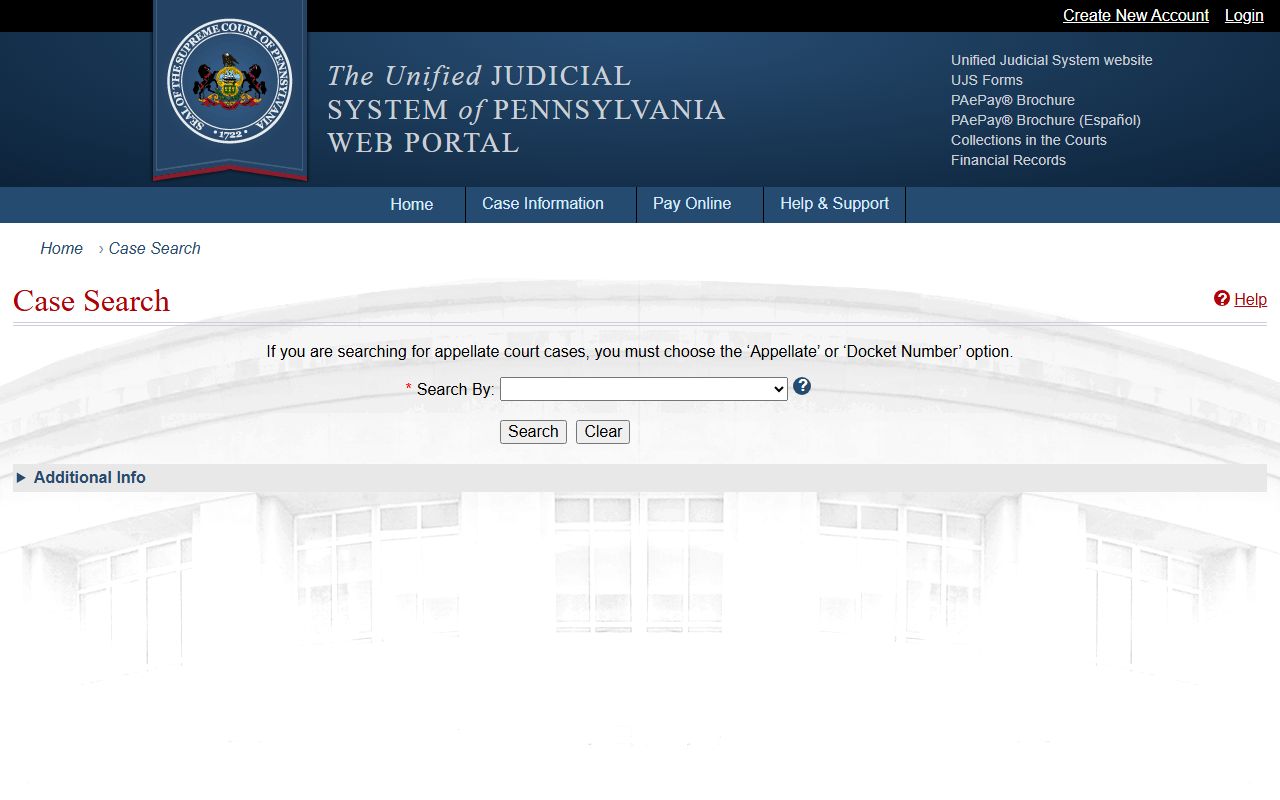
Use the portal for filed court records, then use jail or Open Records channels for booking details that do not appear on a docket sheet.
Monroe County Court Search Fields
UJS Case Search accepts several lookup paths. A docket number is the cleanest search key, but many people start with a defendant name and then narrow by county and dates. Magisterial District Court dockets may appear before a Common Pleas docket exists, especially soon after an arrest.
| Field Label | Type | Required | Options / Format Notes |
|---|---|---|---|
| Search category / docket type | Tab or dropdown | Yes by workflow | Choose Magisterial District Court for preliminary cases or Common Pleas for CP criminal cases. |
| Participant Name | Text | No if docket number used | Search defendant last and first name; use Monroe County to reduce false matches. |
| Docket Number | Text | No if name used | Use an MJ or CP docket number from court paperwork. |
| County | Dropdown | Optional but recommended | Select Monroe for local cases. |
| Date filed / date range | Date fields | Optional | Use arrest, filing, or hearing dates when known. |
| Search / Clear | Buttons | N/A | Search submits the query; clear resets the fields. |
Monroe County Arrest Charging Records
The arresting police agency may start a Monroe County criminal case by filing a complaint in Magisterial District Court. The preliminary arraignment addresses the filed charges, rights, bail, and notice of the next hearing. If charges are held for court, the case moves to the Monroe County Court of Common Pleas, where the prosecutor may proceed through a criminal information.
An indictment is not the ordinary route for a typical Monroe County state criminal case. It is more often tied to grand-jury or federal practice. That matters because a jail booking label may not match the final court record. The prosecutor can amend, add, withdraw, reduce, or dismiss charges as the case develops.
| Document | Usual Role | Where It Fits in Monroe County | Record Tip |
|---|---|---|---|
| Criminal complaint | Starts the lower-court criminal case. | Used around arrest, preliminary arraignment, and the MDJ docket. | Look for the earliest filed charges and offense date. |
| Criminal information | Formal prosecutor filing after a case is held for court. | Filed by the Monroe County District Attorney in Common Pleas cases. | Compare it with the complaint for charge changes. |
| Indictment | Grand-jury or federal charging document. | Not the routine path for most local Pennsylvania state charges. | Check federal court or other sources if the case is federal. |
Monroe County Charge Status Records
Court records after a jail arrest are snapshots of a moving case. A charge can begin as pending, be amended after review, be dismissed at a preliminary hearing, or be resolved through a plea, verdict, or sentencing order. The public docket can show charge statutes, grading, counts, court events, attorney entries, bail entries, disposition, and costs or fines when those items are public.
| Status | What It Means | Where to Verify |
|---|---|---|
| Pending | The charge is still active and no final disposition is shown. | UJS docket events and upcoming hearing list. |
| Held for court | The charge moved from the MDJ stage toward Common Pleas review. | MDJ docket transcript and CP docket when opened. |
| Amended or reduced | The prosecutor or court changed the charge, grade, count, or description. | Charge list and docket entries. |
| Withdrawn or dismissed | The charge is no longer being prosecuted in that form. | Disposition field and docket notes. |
| Guilty plea or verdict | The case reached a conviction on that charge or count. | Disposition and sentencing entries. |
Monroe County Bail After Arrest
Pennsylvania bail is set by a bail authority or court, not by the jail website alone. Rule 524 covers release types such as recognizance, nonmonetary conditions, unsecured bail, nominal bail, and monetary conditions. Rule 528 allows a monetary condition when needed to secure appearance and compliance, and may permit a deposit when the rule and court order allow it.
PAePay Bail Online is the official electronic payment channel for eligible Magisterial District Court and Common Pleas bail payments. Not every Monroe County case can be paid online. Some require directions from the issuing authority, the court clerk, or facility staff. A detainer, probation or parole hold, out-of-county warrant, federal hold, or ICE custody issue can still block release after bail is paid.
| Bail / Release Type | Plain Meaning | Monroe County Lookup Channel |
|---|---|---|
| Recognizance | Release on a written promise to appear and comply. | UJS docket or MDJ paperwork. |
| Nonmonetary conditions | Release with rules such as reporting, travel limits, or no contact. | Court order and docket entries. |
| Unsecured bail | Money is owed only if the person fails to appear or violates conditions. | Court order or docket. |
| Monetary condition | Cash or approved security must be posted for release. | PAePay Bail if eligible, or the issuing court. |
| Detainer or hold | Another agency or court can keep the person in custody. | Jail, court, probation, DOC, BOP, or ICE channel as applicable. |
The official PAePay Bail portal screenshot at PAePay Bail Online shows the state payment route for eligible Pennsylvania bail matters.
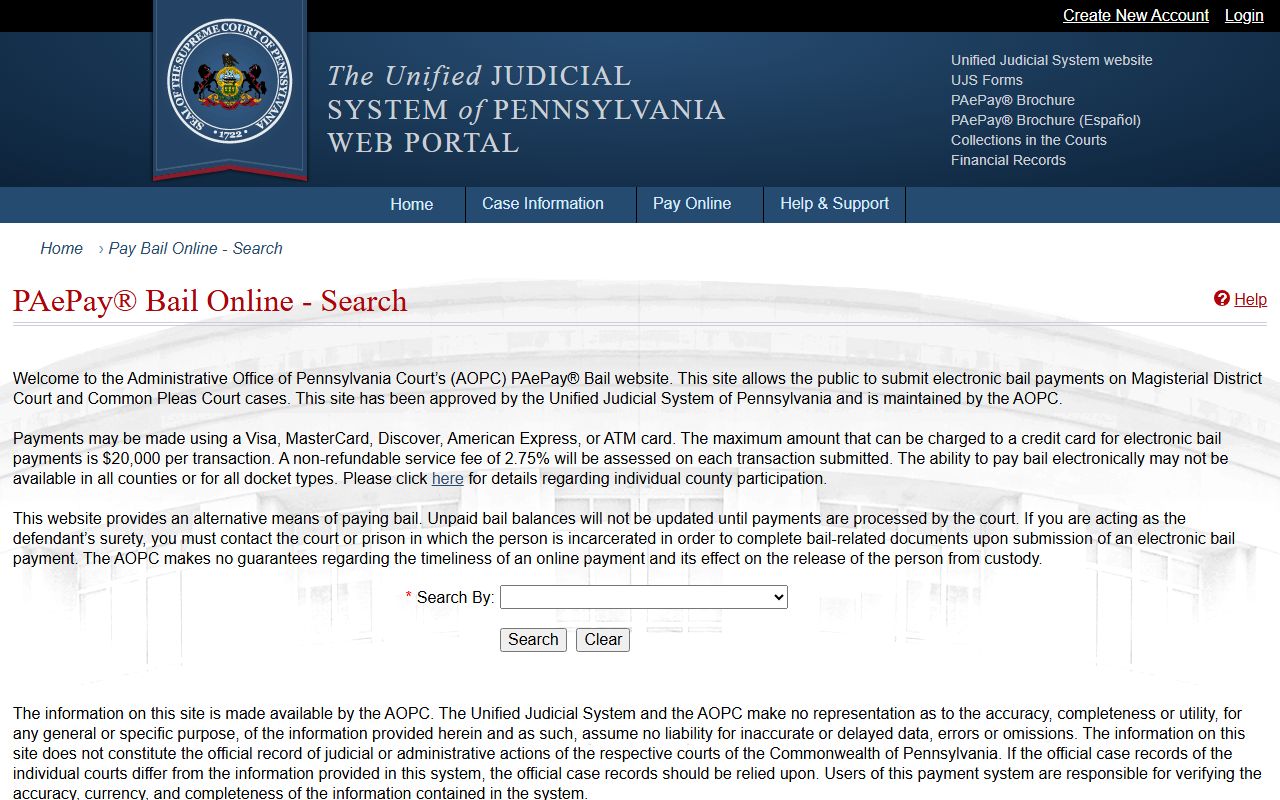
Use PAePay as a payment search tool only after the court has set an eligible bail condition.
Monroe County Bench Warrant Arrests
Monroe County publishes an official Active Bench Warrant Search. The Sheriff's Office links to that county-hosted search from its official page. A bench warrant can lead to arrest and booking if the person is picked up and not released by the court. After that, court records and jail custody records should be checked together.
A bench warrant is a court-issued warrant, often tied to failure to appear or violation of a court order. An arrest warrant authorizes an arrest on criminal allegations. A fugitive or out-of-county warrant can create a local hold even when the new Monroe County matter appears simple. The jail cannot quash a warrant; the issuing court controls that status.
Warrant note: A possible warrant hit should be verified through the court, Sheriff's Office, or counsel before anyone relies on it for release planning.
Monroe County Prosecutor Records
The Monroe County District Attorney county page and the official District Attorney website identify the prosecutor's office for county criminal cases. The District Attorney is not the jail operator and not the court clerk. The office matters because it decides prosecution strategy after the arrest, including charge amendments, withdrawals, plea offers, and formal filings after an MDJ case is held for court.
That role is why booking allegations can differ from court records after a jail arrest. Police may file a complaint, the MDJ may hold some charges for court, and the prosecutor may file a criminal information in Common Pleas. UJS Case Search is the public docket path for comparing the jail-side arrest description with the formal filed charges.
Monroe County Charges vs Convictions
A charge is an accusation in a court record. A conviction is a formal result after a guilty plea, verdict, or qualifying disposition. Public court records after a Monroe County arrest can show both, but they are not the same. Treat pending charges as allegations unless the docket shows a conviction or final outcome.
| Point | Charge | Conviction |
|---|---|---|
| Stage | Filed allegation in the criminal case. | Final or qualifying court outcome. |
| Proof | Can proceed from complaint, hearing, or prosecutor filing. | Requires plea, verdict, or court finding. |
| Record reading | Check status and disposition before drawing conclusions. | Check sentence, grading, and count-specific result. |
Monroe County Sealed Arrest Records
Public access to court records after an arrest is broad, but it is not unlimited. The UJS public-records policies and the Case Records Public Access Policy control many judicial records. County agency records, such as some booking or release records, may be handled through Monroe County Open Records under Pennsylvania's Right-to-Know Law.
Expungement is different from sealing or limited access. Pennsylvania's 18 Pa.C.S. Section 9122 sets expungement circumstances for eligible criminal history record information. CHRIA rules, including 18 Pa.C.S. Section 9121, govern dissemination of criminal history record information by criminal justice agencies.
| Record Treatment | Plain Meaning | Practical Effect |
|---|---|---|
| Public docket | The record is available through public court channels. | Search UJS or request through court access channels. |
| Limited or sealed access | Public viewing is restricted by policy, rule, or court order. | Some agencies or parties may still have access. |
| Expunged | Eligible criminal history record information is removed under court order. | Use the court order with the agencies that hold the record. |
Monroe County Public Court Access
Use the right public-access channel for the record type. Judicial records are searched through UJS Case Search, the Monroe County Court of Common Pleas, or Magisterial District Judge offices. Executive-branch county records, such as certain booking or release records held by county offices, can be requested through Monroe County Open Records and the county request form.
The Pennsylvania Right-to-Know Law, Act 3 of 2008, creates the general local-agency records framework, subject to exemptions. CHRIA and investigative-record limits can affect law-enforcement details. For custody notifications rather than full records, Pennsylvania VINELink is the appropriate alert channel when the person appears in a participating system.